
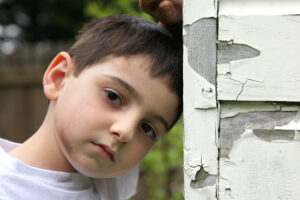
Children traumatised by neglect and abuse experience a double-whammy, negative effect in relation to shame. Firstly, their experiences mean that they are hypersensitive to shame and unable to tolerate it. Secondly the on-going need, of such children, to act out their attachment strategies results in challenging behaviour that causes the adults around them to use reward-punishment strategies, which relies upon the impact of shame to modify behaviour. Therefore, fostered and adopted children are compelled to behave in accordance with their hard-wired attachment strategies and trauma experiences, while being simultaneously told that they are bad for acting in this way, causing shame on top of shame.
Children’s hypersensitivity to, and difficulty in tolerating, shame comes from their earliest abusive and/or neglectful experiences. The effect of such experiences is to give children an overdose of shame. Abuse and neglect are shaming for babies and young children because, unable to understand the social world or the minds of other people, all they have is themselves. So when they, unconsciously, try to make sense of the parenting they receive the only person that can possibly be in control, and therefore responsible, is themselves. Therefore, babies can only interpret their experiences as their own fault; that they are deserving of the treatment they receive and they are therefore unconsciously ashamed of themselves for warranting such treatment.
Babies do not have any concept of the idea that other people have minds that are different to their own. If they did they may able to understand that the responsibility for the treatment they receive is someone else’s. Instead, infants digest the abusive treatment as simply another bit of feedback about themselves and the world around them. The abusive treatment is feedback about their worth. Everybody, including babies, experiences shame if they feel that they are deserving of disapproval, negative judgement and/or punishment from others.
The second part of the developmentally traumatised child’s relationship with shame is that they experience shame every time they are unable to do what is expected of them. Children’s emerging awareness of their persistent failure and parents’ and carers’ typical, reward-punishment ways of dealing with behaviour reinforces children’s ideas of themselves as bad and does little to help them to change their behaviour.
In order to try and understand this idea we must first accept that traumatic early life causes children to develop strategies for relating to other people and themselves which are adaptive to that context. i.e. the strategies that make sense and/or were very useful in babyhood. Examples of such strategies are; not sleeping, being controlling, being aggressive, being loud and/or impossible to ignore. These strategies are vital; they have potentially saved your child’s life on many occasions and they have certainly saved them from even greater emotional and psychological damage than they would have otherwise experienced.
The attachment strategies that children develop are as fundamental, essential and as compulsive as the urge to swim if you fall out of a boat, or the urge to run if a fast car is approaching. They are life-saving strategies. If I tried to train you not to do either of these things, despite the danger, you would either succeed in your training and die or you would fail in your training and survive, but both you and I (as the teacher of such a strategy) would be disappointed in you. When we use reward-punishment thinking with the attachment strategies of fostered and adopted children we are asking them to do the former. We, of course, “know” that they won’t suffer harm if they allow themselves to be trained. However, your child “knows” just as absolutely that this strategy is indeed essential and allowing themselves to be trained out of it is dangerously foolhardy. As a result, the child will invariably have no option but to take the second option; disappoint you, by not being amenable to your training, but maintain their survival strategies. The result is that your child feels more and more ashamed of not being able to do what we communicate that they can do via our expectations and disciplining of their behaviour.
Because traumatised children are hypersensitive to shame (they’ve previously been given an overdose of it) even the smallest amounts of shame can be intolerable. As you can see above, such children are routinely exposed to large amounts of shame through the use of reward-punishment thinking and so extreme behaviour and psychological damage can be triggered by typical, reward-punishment, parenting methods.
The natural and normal way of coping with intolerable emotions for all of us is to develop a defensive strategy. Therefore, when exposed to shame, adopted and fostered children will often become “defensive” e.g. through lying, or by reacting to you with dismissive but protective statements e.g. “I didn’t even want the TV in my room anyway”, “you’re always horrible to me, you hate me”, “I don’t care what you say”. The alternative to defensive strategies is some form of emotional disintegration e.g. dissociation (disappearing into a bubble), extreme dysregulated rage or despair. When a child is reacting defensively they cannot learn anything about their behaviour; they are necessarily detached from anything lesson you try to teach them.