
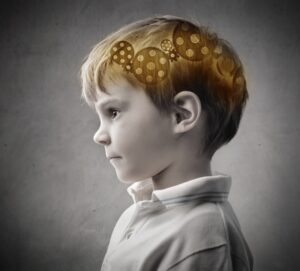
Most of us assume that human brains are fixed in their growth by the time of birth. We all expect that brains grow and absorb more information as children grow; like the knowledge of how to walk, talk and ride a bike but fundamentally, brains, like bones, hands and faces are pretty much finished products, right? Well, no, the brains of newborn human babies are still completely mouldable and very much dependent upon what they experience in the two or three years after birth.
In effect human babies are born too early. They are born before their brains are developed enough, and ready to handle, the physical independence that other mammals manage straightaway. This has allowed us, as a species, to evolve smaller pelvises so that we can stand on two legs and use our hands to be more productive. It’s been an incredibly useful evolutionary transformation for our species but it means that the brains of new-born babies have to do the vast majority of their brain growth after birth. This means that the development of our psychological stability is very vulnerable if the world around us at that time is not protective, nurturing and safe.
The advantage of this process is that humans develop and adapt our brain development to fit in with our environments, which means that we grow to be suited to own environments i.e. it allows us to hard-wire into our brains, at the earliest opportunity, the most useful strategies for the environment in which we are born.
Even before they are born many fostered and adopted children will have developed the very first parts of their brain in conditions that were far from ideal. Many babies are exposed to alcohol, drug use and violence, as well as the fear, depression and/or anxiety neurochemicals of their mothers. Public health guidance has helped to raise awareness of the toxic environment created by the external chemicals delivered directly to babies in utero e.g. via smoking and drinking alcohol but we have an awful lot of catching up to do in terms of understanding the toxic chemical soup produced internally around unborn babies through maternal exposure to violence, depression, anxiety and/or other stress.
The most important neurochemical to know about when seeking to understand the brain development of fostered and adopted children is the stress hormone, cortisol. Cortisol is a perfectly normal neurochemical that everybody produces in times of stress and is, in most cases, harmless. However, the amounts that are produced in infants who are abused and/or neglected combine with the fragility of their new brains means that cortisol can be extremely toxic to babies. Babies are thought to develop a “set-point” for cortisol levels by six months old. That means that what a child considers to a “normal” level of stress has become hard-wired before they’re even able to utter their first word.
The effects of abuse and/or neglect, and the excessive levels of cortisol that they cause the brain to produce, impacts most severely on the pre-frontal cortex (right behind our foreheads) and the limbic system (the second deepest layer of the brain).
The pre-frontal cortex (a.k.a. the neo-mammalian brain), when we have one that works well, helps us to think about the future, understand cause and effect, have empathy and manage strong impulses and emotions. These sophisticated cognitive abilities are also known as Executive Functions.
The limbic system (aka the mammalian brain) is where understandings and expectations of relationships and emotional safety sit in our brains.
Astonishingly, there is also new evidence emerging that even the development of the most primitive parts of a person’s brain; the diencephalon and brain stem (aka the reptilian brain) are held back by early abuse and neglect. For example, such basic functions as the ability to swallow and regulate temperature may be seriously impaired in traumatised children. When children have not had the parenting that has enabled them to fully develop these areas of their brains they will struggle with even such fundamental things.
So, are children that have been abused and/or neglected beyond our help? It’s an understandable question because when we start to talk about brain development it’s easy to become intimidated and imagine that that the brain is too complex and surely not influenced by anything we can do. The fantastic news is that the right kind of parenting does indeed mould children’s’ brains. If these problems can be addressed before a child is three years old, it is possible to make a huge difference, not only to a child’s sense of security and safety but also their brains really quite quickly. After three years of age it is still possible to make an enormous difference to children’s brains by providing them with the experiences that they have missed out on. It is, however, often much slower by this stage as the brain has already become quite set in its ways by this stage in its development. However this really should not be a cause for carers and adopters to lose heart about their older children. If you use the right strategies it is entirely possible to make a very substantial difference to your child’s brain anatomy and to their life.
In summary, neuroscience has finally backed up the instinct, that people caring for children traumatised by abuse and/or neglect have known for decades, that such children are stuck in their development in many ways as babies or toddlers. What is wonderful about this is that it provides us with the beginnings of the scientific ideas about how to help.
In order to develop beyond these infantile stages children literally have to be helped to develop new neural pathways. The child’s experience of a loving relationship with their carer, as they use appropriate parenting techniques, is the perfect combination with which foster carers and adoptive parents can help their traumatised child.
Have a look at the top five tips to give you some more practical ideas and do write and tell us about the strategies that you have worked out to promote help your child’s development.